
Do You Really Need a Rack? A Plain-English Guide to the Home Network
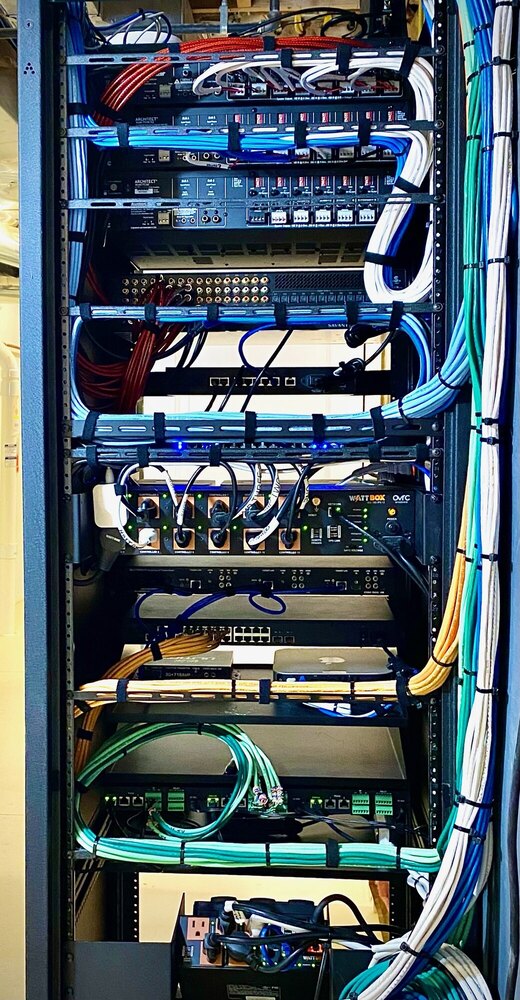
Every house already has a spot where the internet lives. Usually it's a shelf in a closet with a modem, a router, and a power strip holding the whole thing together. A rack is what happens when that spot gets designed instead of inherited.
The question isn't whether a rack is impressive. It's whether your house is asking for one. Some do. Plenty don't.
What a rack actually is
A rack is a standardized frame that equipment bolts into. Network gear, AV amplifiers, controllers, and power all mount at fixed widths so they stack in a known order instead of stacking on each other. That's the whole idea. Everything else follows from it.
The three jobs it does
- It manages heat. Network and AV equipment runs warm, and warm equipment in a sealed closet fails early. A rack gives air somewhere to go, and in bigger systems it gives a fan somewhere to mount.
- It keeps power clean and accounted for. Rack-mounted power means surge protection, sequenced startup, and the ability to reboot one device remotely instead of pulling the plug you hope is the right one.
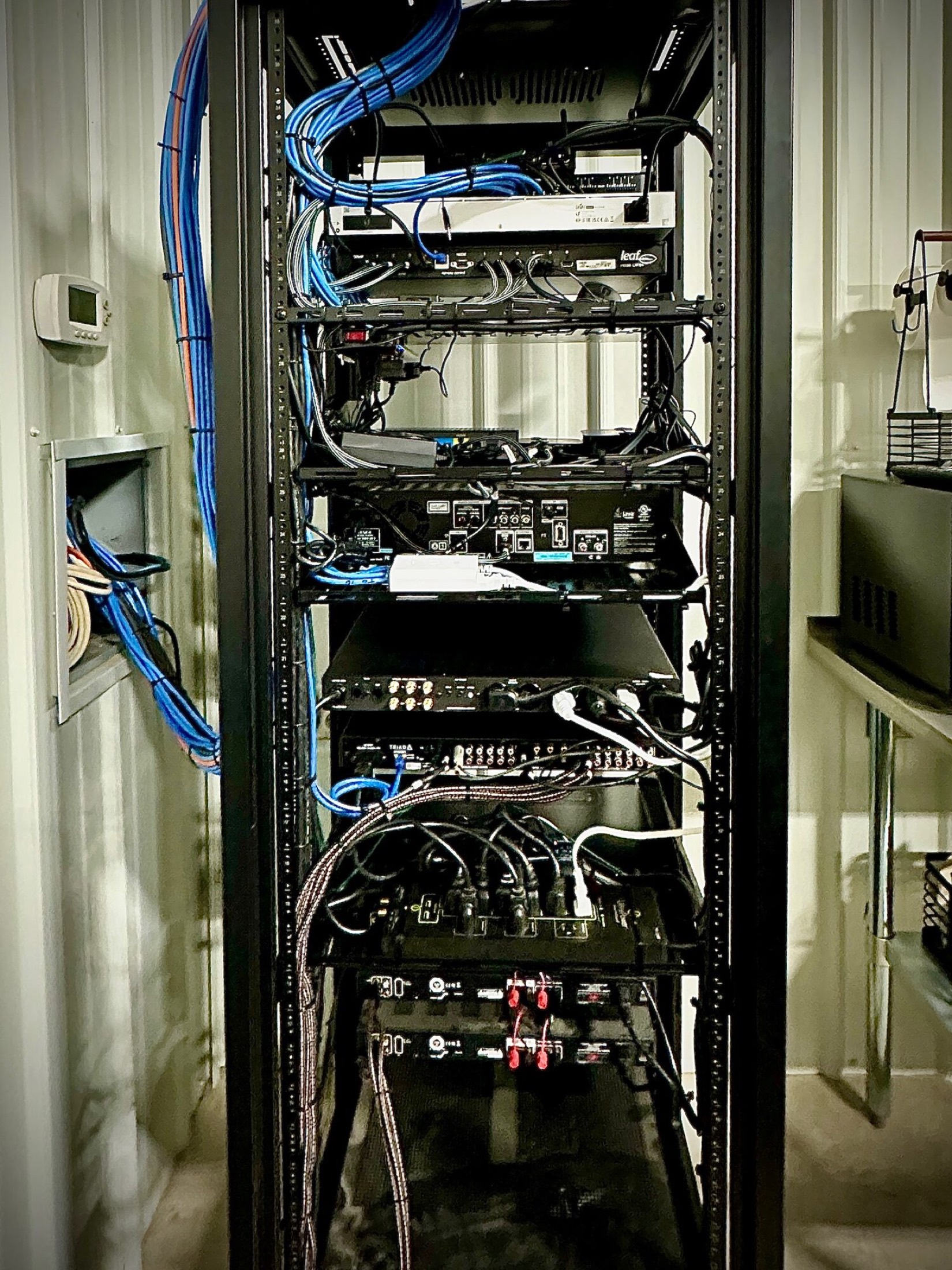
- It makes the system legible. Labeled ports, dressed cable, and a known layout mean the next person to open that door can tell what's happening in ten seconds. That person is often a technician at 8pm, and sometimes it's you.
When you don't need one
A smaller house with one internet connection, a couple of access points, and no distributed audio doesn't need a rack. It needs a tidy structured wiring enclosure, hard-wired connections to the access points, and someone who labeled the cables. A rack there is furniture for equipment that doesn't need furniture.
We say this out loud because racks are easy to oversell. If the honest answer is an enclosure, the answer is an enclosure.
When you do
The threshold isn't square footage. It's how many systems are sharing the same brain.
- Distributed audio. Amplifiers are the single biggest reason a house crosses into rack territory. They're heavy, they're warm, and they multiply.
- More than a handful of access points. Once the network needs a real switch with power over Ethernet, it needs somewhere real to sit.
- A control system. Controllers, lighting processors, and shade hubs each want a permanent home and steady power.
- Cameras with local recording. A recorder is a always-on computer with drives in it, and drives care about heat.
- A house you plan to add to. A rack with empty space is a plan. A full closet shelf is a problem waiting.
What actually lives in one
Racks look mysterious from the outside and are boring on the inside. In a typical Connesso house, from the top down:
- The incoming service and firewall. Where the internet arrives and where the house's network security starts.
- A managed switch with power over Ethernet. This feeds the access points, cameras, and keypads over the same cable that carries their data. One cable per device instead of two.
- The patch panel. Every cable in the house terminates here, labeled by room. This is the single piece that makes a system serviceable ten years later.
- Amplifiers. One or more, depending on how many zones of audio the house runs. These are the heat.
- The control processor and lighting processor. The brains for scenes, schedules, and anything that happens without someone pressing a button.
- A camera recorder, if there is one. Local storage means footage that survives an internet outage.
- Conditioned power at the bottom. Surge protection and sequencing, so equipment starts in the right order after an outage and doesn't all inrush at once.
How big, and why we leave it half empty
Racks are measured in rack units, or U, each one about an inch and three quarters tall. A modest house lands around 12U. A large one with several audio zones and cameras can run 27U or more.
We size up. A rack that's full on day one is a rack that can't absorb the theater you add in year three, and vertical space is the cheapest thing in the whole assembly. Planning roughly a third empty is not waste, it's the part that keeps the next project from becoming a rebuild.
Heat and noise, the two things people forget
Equipment closets get hot in a way that surprises people. Amplifiers idle warm and run hot, and a sealed closet with no return air will sit fifteen or twenty degrees above the rest of the house. That heat is the leading cause of gear that dies at year four instead of year twelve. The fix is ventilation planned during design: a return, a transfer grille, or active rack fans.
Noise is the other one. Fans and drives make a low constant hum that nobody notices in a basement and everybody notices through a bedroom wall. Rack location is an acoustic decision as much as a technical one, which is a good argument for settling it while the walls are still lines on a drawing.
Where it goes
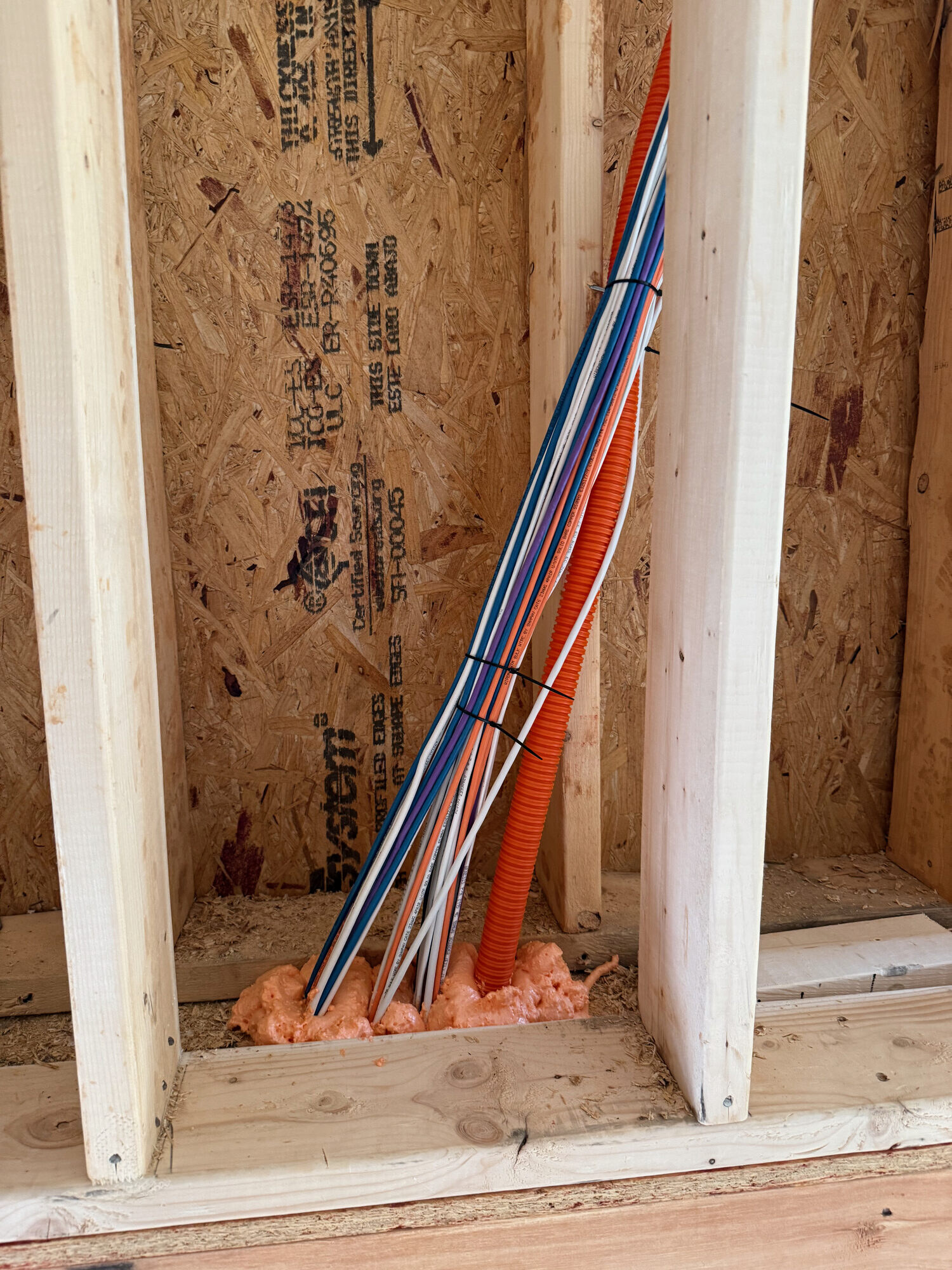
The rack wants a conditioned space, not an attic and not a garage in Ohio in February. It wants a door someone can open without moving storage. It wants a dedicated circuit. And it wants to be reasonably central, because every home run is a cable that has to reach it.
That's a floor plan conversation, which is why it belongs in the drawings and not in a punch list. We size the rack location during design, the same time we're deciding the wiring that feeds it.
What it costs to skip
Nothing, on move-in day. The cost arrives later, in the form of a system nobody can service quickly. Equipment stacked on a shelf gets diagnosed by unplugging things. A labeled rack gets diagnosed by looking. The difference shows up every time something needs attention over the next fifteen years.
What we do differently
Three habits, none of them expensive, all of them the difference between a rack and a pile.
- Every cable labeled at both ends. The panel alone isn't enough. The label at the wall plate is the one that saves an hour when something moves.
- As-built documentation handed over at closing. A drawing of what's where, so the house's system doesn't live only in one technician's memory.
- Remote reboot on the gear that needs it. Most network problems are fixed by power-cycling one device. Being able to do that from the office means a phone call instead of a truck roll.
Common questions
Can a rack go in the garage?
In a conditioned garage, sometimes. In an unconditioned one, no. Temperature swings and humidity are hard on electronics, and Ohio and North Carolina both deliver plenty of both.
Can I add a rack later?
Yes, and it costs more than doing it during construction, mostly because the cables have to reach it. If the home runs already land in one central place, a later rack is a weekend. If they don't, it's drywall work.
Does a rack make the Wi-Fi better?
Not by itself. Wi-Fi quality comes from hard-wired access points placed against the floor plan. The rack is where those access points get their power and their connection, which is a supporting role, not the main one.
If you want the short version: the rack isn't the point. What it protects is. See how we approach networks and connectivity, or send us plans and we'll tell you which one your house needs.